
Dip bars offer a versatile platform for building upper body strength, primarily targeting the triceps, chest, and shoulders through various exercises.
These parallel bars are ideal for calisthenics, providing a foundation for a comprehensive workout routine, suitable for all fitness levels.
A dip bar routine can be easily structured into a PDF for convenient access and tracking of progress, enhancing your fitness journey.
What are Dip Bars?
Dip bars, also known as parallel bars, are a fundamental piece of equipment for bodyweight training, consisting of two sturdy, parallel bars designed to support a person’s weight. They are commonly found in gyms, parks, and can even be installed at home for dedicated fitness enthusiasts.
These bars facilitate a range of exercises, most notably dips, but also including push-ups, Australian pull-ups, and leg raises. Their simple yet effective design allows for a full upper-body workout, focusing on the chest, triceps, and shoulders.
Creating a dip bar exercises PDF allows users to easily access and follow structured routines, maximizing the benefits of this versatile equipment. The bars provide a stable platform for progressive overload, making them suitable for beginners to advanced athletes.
Benefits of Dip Bar Training
Dip bar training offers a multitude of benefits, primarily focusing on upper body strength and muscle development; Regular use significantly enhances triceps strength, as they comprise a substantial portion of the upper arm, contributing to overall arm size and definition.
Beyond the triceps, dip bar exercises effectively target the chest and shoulder muscles, promoting a well-rounded physique. The ability to perform various exercises – dips, push-ups, and rows – makes it a versatile training tool.
A well-structured dip bar exercises PDF can help individuals track progress and maintain consistency. Furthermore, bodyweight training improves functional strength, enhancing everyday movements and athletic performance. It’s an accessible and effective method for building strength without relying on heavy weights.

Basic Dip Bar Exercises for Beginners
Dip bars are excellent for foundational strength training, offering accessible exercises like dip bar push-ups and Australian pull-ups, perfect for a beginner PDF.
Dip Bar Push-Ups
Dip bar push-ups are a fantastic entry point for beginners utilizing dip bars, and a key component of any introductory dip bar exercises PDF. This exercise effectively strengthens the chest, shoulders, and triceps, building a solid foundation for more advanced movements.
To perform a dip bar push-up, position yourself between the bars with your hands shoulder-width apart, supporting your weight with straight arms. Lower your body by bending your elbows, maintaining control, until your chest nearly touches the bars. Push back up to the starting position, fully extending your arms.
Focus on maintaining proper form – a straight back and controlled movements – to maximize effectiveness and minimize risk of injury. Including variations, like wider or narrower hand placements, can be detailed within your PDF for progressive overload.
Australian Pull-Ups (Inverted Rows)
Australian pull-ups, also known as inverted rows, are a superb exercise for building back and bicep strength using dip bars, and should be included in any well-rounded dip bar exercises PDF. This movement is particularly beneficial for beginners who may not yet have the strength for traditional pull-ups.
Lie on the floor beneath the dip bars and grip them with an overhand grip, slightly wider than shoulder-width. Your body should form a straight line from head to heels. Pull yourself up towards the bars, squeezing your shoulder blades together, until your chest touches the bars.
Slowly lower yourself back down to the starting position, maintaining control throughout the movement. Adjusting your body angle alters the difficulty; a more horizontal position is easier. Your PDF should detail these modifications.
Bodyweight Dips – Proper Form
Mastering proper form is crucial for effective and safe bodyweight dips, a cornerstone of any dip bar exercises PDF. Begin by gripping the dip bars with your palms facing each other. Lift yourself off the bars, locking your elbows. Slowly lower your body by bending your elbows, keeping them tucked in close to your sides.
Descend until your upper arms are parallel to the ground, or as low as your flexibility allows. Avoid flaring your elbows, as this can strain your shoulders. Push back up to the starting position, fully extending your arms but avoiding locking your elbows at the top.
A detailed PDF should include images demonstrating correct posture and common mistakes to avoid, ensuring users perform the exercise safely and maximize results.

Intermediate Dip Bar Exercises
Dip bar exercises PDF guides often progress to chest and close-grip dips, increasing intensity. These variations effectively target the pectorals and triceps for enhanced strength.
Chest Dips – Targeting the Pectorals
Chest dips are a fantastic intermediate dip bar exercise, prominently featured in many dip bar exercises PDF guides. To perform them effectively, grip the bars with a slightly wider stance than shoulder-width, leaning forward slightly during the descent.
This forward lean is crucial; it shifts the focus from the triceps to the pectoral muscles. Lower your body until your upper arms are parallel to the ground, maintaining control throughout the movement.
Push back up to the starting position, fully extending your arms, but avoid locking your elbows. Proper form is paramount to maximize pectoral engagement and minimize the risk of shoulder injury. A well-structured PDF will illustrate correct technique.
Focus on feeling the contraction in your chest throughout the exercise for optimal results;
Close-Grip Dips – Isolating the Triceps
Close-grip dips are a powerful dip bar exercise, often highlighted in dip bar exercises PDF resources, specifically designed to isolate and strengthen the triceps brachii. To execute this exercise, position your hands on the bars with a narrow grip, keeping your elbows tucked close to your body throughout the movement.
This close positioning minimizes chest involvement, directing the workload primarily to the triceps. Lower your body until your upper arms are at least parallel to the ground, controlling the descent.
Push back up, fully extending your arms, but avoid locking your elbows at the top. Maintaining a controlled tempo is vital for maximizing triceps activation. A detailed PDF guide will demonstrate proper form and technique.
Remember to focus on squeezing the triceps at the peak contraction.
Wide-Grip Dips – Focusing on the Chest
Wide-grip dips, frequently detailed in comprehensive dip bar exercises PDF guides, are an excellent variation for emphasizing pectoral muscle development. Unlike close-grip dips, a wider hand placement shifts the primary focus from the triceps to the chest. Position your hands on the dip bars significantly wider than shoulder-width apart.
As you lower your body, allow your elbows to flare out slightly to further engage the chest muscles. Descend until your upper arms are below parallel to the ground for a fuller range of motion.

Push back up, concentrating on contracting the pectoral muscles. A well-structured PDF will illustrate the correct body angle and hand positioning.
Maintaining control throughout the movement is crucial for preventing injury and maximizing chest activation.

Advanced Dip Bar Exercises
Advanced dip bar exercises, often detailed in a dip bar exercises PDF, challenge strength and muscle mass with techniques like weighted dips and ring dips.
These variations demand greater control and stability.
Weighted Dips – Increasing Resistance
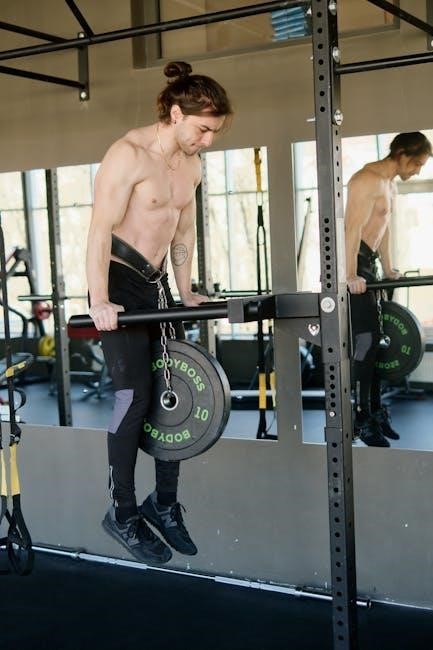
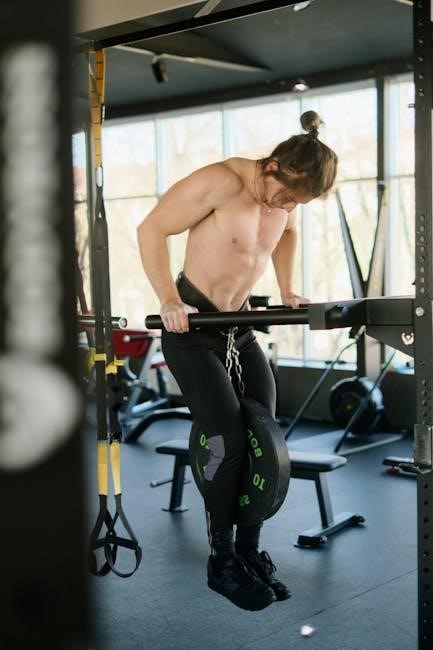
Weighted dips represent a significant progression in dip bar training, detailed effectively within a comprehensive dip bar exercises PDF guide. Once bodyweight dips become manageable, adding resistance is crucial for continued strength gains and muscle hypertrophy.
This can be achieved using a weight belt, holding a dumbbell between your feet, or wearing a weighted vest. Start with a small increment – 2.5 to 5 pounds – and gradually increase the weight as your strength improves. Maintaining proper form is paramount; avoid swinging or using momentum to complete the exercise.
A well-structured PDF will illustrate correct technique, emphasizing controlled movements and a full range of motion. Remember to prioritize form over weight to prevent injuries and maximize the effectiveness of this challenging exercise. Detailed instructions within the PDF should cover safe weight addition protocols.
Decline Dips – Emphasizing the Lower Chest
Decline dips are a powerful variation, effectively targeting the lower pectoral muscles, and should be thoroughly explained within a detailed dip bar exercises PDF. This is achieved by elevating your feet on a stable platform during the dip, shifting the emphasis away from the upper chest and triceps.
A PDF guide should illustrate proper foot placement – ensuring stability and controlled movement. Begin with a moderate elevation and gradually increase it as strength improves. Maintaining a slight forward lean enhances lower chest activation.
Remember, controlled descent and ascent are vital. Avoid rushing the movement or using momentum. A comprehensive PDF will include safety precautions and modifications for different fitness levels, ensuring a safe and effective workout. Proper form, as demonstrated in the PDF, is key to maximizing results and preventing injury.
Ring Dips – Enhanced Range of Motion
Ring dips represent an advanced dip bar exercise, demanding significant strength and control, and deserve a dedicated section within a comprehensive dip bar exercises PDF. Unlike standard dips, gymnastic rings allow for a fuller range of motion, increasing muscle activation and flexibility.
A detailed PDF should visually demonstrate the correct starting position, emphasizing shoulder blade retraction and core engagement. The rings’ instability requires greater stabilization, engaging more muscle groups.
The PDF must highlight the importance of controlled descent, allowing for a deep stretch in the chest and shoulders, followed by a powerful, controlled ascent. Safety considerations, including proper ring height and grip strength, are crucial; Modifications for beginners, such as assisted ring dips, should also be included in the PDF.

Dip Bar Exercises for Lower Body
Dip bars aren’t just for upper body strength; a dip bar exercises PDF should include leg and knee raises for a complete lower body workout!
These exercises effectively target core and leg muscles, adding variety to your routine.
Dip Bar Leg Raises
Dip bar leg raises are a fantastic lower body exercise that should be included in any comprehensive dip bar exercises PDF. To perform this exercise, securely grip the dip bars and allow your legs to hang straight down.
Engage your core muscles and slowly raise your legs, keeping them straight or slightly bent, until your thighs are parallel to the ground or higher. Focus on controlled movements, avoiding swinging or using momentum.
Slowly lower your legs back to the starting position, maintaining core engagement throughout the entire exercise. This movement effectively targets the lower abdominal muscles, hip flexors, and core stabilizers.
Beginners can start with bent-knee raises, gradually progressing to straight-leg raises as their strength improves. Proper form is crucial to prevent injury and maximize effectiveness.
Dip Bar Knee Raises
Dip bar knee raises are an excellent addition to your dip bar exercises PDF, offering a great way to strengthen your core and lower abdominal muscles. Begin by firmly grasping the dip bars, allowing your legs to hang freely below you.

Engage your abdominal muscles and slowly bring your knees up towards your chest, maintaining a controlled motion. Focus on squeezing your core as you lift your knees, avoiding swinging or using momentum.
Hold the contracted position briefly, then slowly lower your legs back to the starting position. This exercise is particularly beneficial for beginners as it requires less strength than straight-leg raises.
Incorporating dip bar knee raises into your routine will improve core stability and contribute to a well-rounded fitness program. Remember to prioritize proper form to maximize results and prevent injury.

Safety Considerations & Form
Dip bar exercises PDF guides should emphasize proper form and safety; always warm up, use correct technique, and follow all safety instructions diligently.
Warm-up Exercises Before Dip Training
A comprehensive dip bar exercises PDF should always prioritize a thorough warm-up routine. Begin with five to ten minutes of light cardio, such as jumping jacks or arm circles, to increase blood flow to the muscles.
Dynamic stretching is crucial; include arm swings, shoulder rotations, and wrist flexions. These movements prepare the joints and muscles for the demands of dip training.
Specifically target the chest, shoulders, and triceps with exercises like band pull-aparts and light push-ups.
Don’t neglect the core – incorporate planks or torso twists. A proper warm-up minimizes the risk of injury and maximizes performance during your dip bar workout.
Remember to listen to your body and adjust the intensity as needed.
Proper Form and Technique
Your dip bar exercises PDF must emphasize correct form to prevent injuries and maximize results. Maintain a controlled descent during dips, lowering yourself until your elbows are at a 90-degree angle.
Keep your core engaged throughout the movement, preventing excessive swinging. Avoid locking your elbows at the top of the dip.
For push-ups on dip bars, ensure your body forms a straight line from head to heels.
During Australian pull-ups, focus on squeezing your shoulder blades together. A detailed dip bar guide should include visual aids demonstrating proper technique for each exercise.
Prioritize quality over quantity; slow, controlled movements are more effective than rushed repetitions.
Safety Instructions & Precautions
Your dip bar exercises PDF should prominently feature safety guidelines. Always inspect the dip bars for stability before each workout, ensuring they are securely fastened.
Use a spotter, especially when attempting weighted dips or advanced variations. Begin with bodyweight exercises to build a foundation of strength before adding resistance.
Maintain three points of contact with the bars during exercises to prevent slipping.
Avoid performing dip bar exercises if you have pre-existing shoulder or elbow injuries.
Proper warm-up and cool-down routines are crucial. Listen to your body and stop if you experience any pain.
Never exceed your fitness level.
Creating a Dip Bar Workout PDF
Dip bar exercises PDF creation allows for organized workout plans, tracking progress, and convenient access to routines.
Structure your PDF with exercises, sets, reps, and safety notes for effective training.
Structuring Your Dip Bar Workout
Creating a dip bar exercises PDF requires a thoughtful structure for optimal results. Begin by categorizing exercises based on muscle groups – chest, triceps, shoulders, and legs.
Within each category, arrange exercises from beginner to advanced, allowing for progressive overload. Clearly define sets, repetitions, and rest periods for each exercise. Include detailed instructions and visual aids (images or diagrams) demonstrating proper form.
Consider incorporating warm-up and cool-down routines within your PDF; A sample weekly schedule can enhance usability, alternating between upper and lower body focus. Finally, dedicate a section to safety precautions and modifications for different fitness levels, ensuring a safe and effective dip bar experience.
Sample Dip Bar Workout Routine
Here’s a sample routine for your dip bar exercises PDF, designed for intermediate fitness. Warm-up: 5 minutes of light cardio and dynamic stretching.
Workout: 3 sets of 8-12 repetitions for each exercise. Begin with Dip Bar Push-Ups, followed by Australian Pull-Ups (3 sets of as many reps as possible). Next, perform Chest Dips, focusing on controlled movements. Include Close-Grip Dips to isolate the triceps. Finish with Dip Bar Leg Raises (3 sets of 15-20 reps).
Cool-down: 5 minutes of static stretching, holding each stretch for 30 seconds. Remember to adjust sets and reps based on your fitness level. This routine can be incorporated into a weekly schedule, alternating with rest days for optimal recovery.